

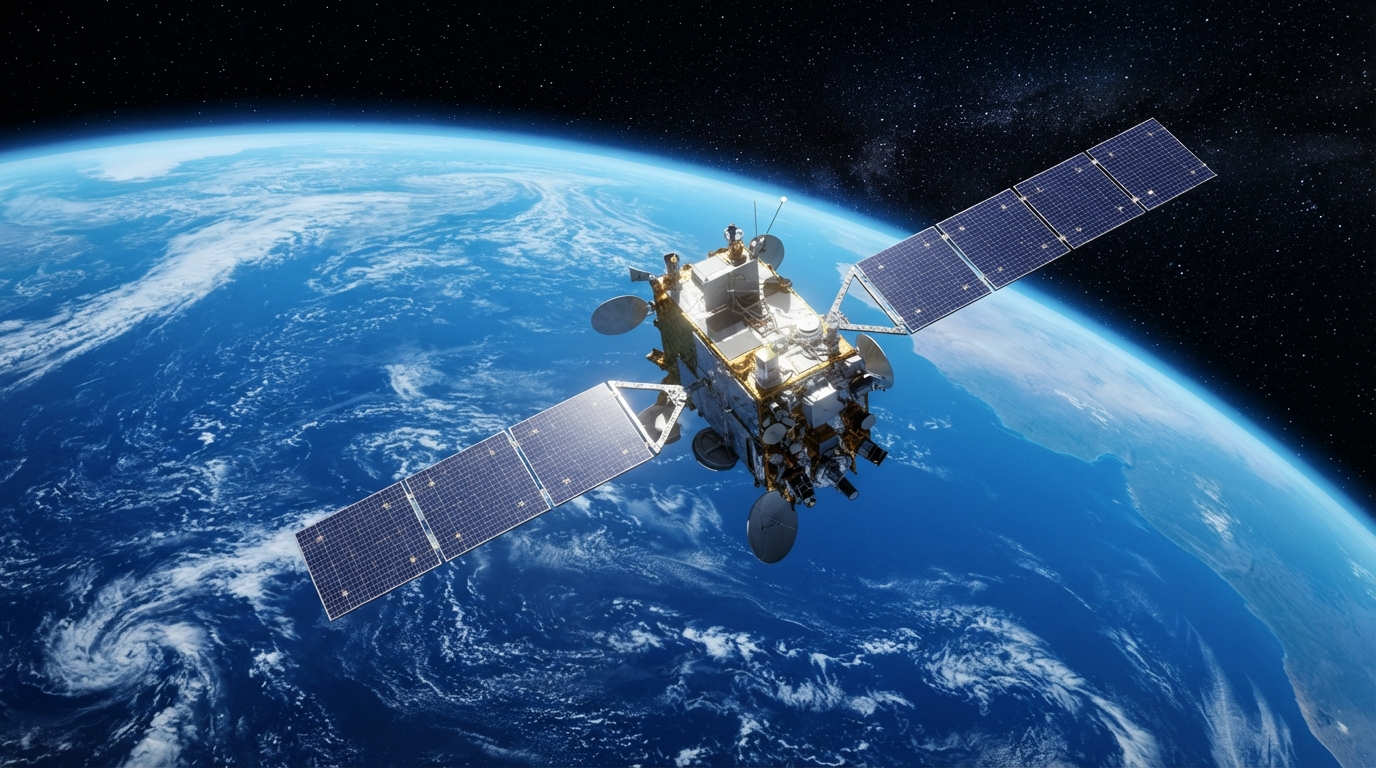
A space orbit is a curved path an object follows around a planet or star due to gravity and forward velocity working together. Understanding space orbits helps explain how satellites, space stations, and planets stay in motion without falling or flying away.
Look up at the night sky and you’ll spot something extraordinary—thousands of satellites silently tracing invisible paths around Earth, while the Moon holds steady in its familiar arc overhead. None of them are anchored. None of them have engines running 24/7. Yet they don’t fall, and they don’t drift away.
That’s the quiet magic of a space orbit.
For most people, orbits feel like an advanced topic buried in textbooks. But the truth is, the core idea is surprisingly accessible. Once you understand the basic forces at play, a space orbit stops feeling like a mystery and starts feeling almost obvious. This guide breaks it all down from scratch—the physics, the types, the real-world applications, and the most common misconceptions people carry around without realizing it.
Whether you’ve always been curious about how GPS satellites stay perfectly positioned, or you’ve wondered why the International Space Station doesn’t just plummet to Earth, this guide has you covered. No physics degree required.
What Is a Space Orbit, and How Does It Work?
At its most fundamental level, a space orbit is the curved path one object takes around another due to the force of gravity. The Moon orbits Earth. Earth orbits the Sun. Satellites orbit Earth. In every case, the same core principle applies.
But here’s the part that surprises most beginners: an orbit isn’t just falling. It’s falling while moving sideways fast enough to keep missing the ground.
Picture throwing a ball horizontally. It curves downward and hits the ground. Now throw it faster. It travels farther before hitting the ground. Throw it fast enough—roughly 7.9 kilometers per second near Earth’s surface—and the curve of the ball’s descent matches the curve of Earth itself. The ball keeps falling, but it keeps missing. That’s a space orbit.
This balance between gravity pulling an object inward and the object’s forward momentum carrying it sideways is what keeps any orbiting body in its path. Disrupt that balance—either by slowing down or speeding up dramatically—and the orbit changes or ends entirely.
Why Do Satellites Not Fall to Earth?
This is one of the most commonly asked questions about space, and the answer lies in a concept called orbital velocity. Satellites are indeed falling toward Earth constantly. The key is that they’re also moving sideways so fast that Earth curves away beneath them at the same rate they fall.
To maintain a stable low Earth space orbit, a satellite must travel at approximately 7.8 kilometers per second—or about 28,000 kilometers per hour. At that speed, for every meter a satellite falls due to gravity, Earth’s surface curves away by the same amount. The result is a continuous, stable space orbit.
Satellites don’t have engines firing constantly to stay up. Once placed in orbit, they need only occasional small thruster bursts to compensate for the slight atmospheric drag experienced in lower orbits. The physics does the rest.
This is also why satellite launches don’t just go straight up. Rockets curve sideways as they ascend, building horizontal speed. Getting to orbit is less about escaping gravity and more about moving fast enough sideways to turn the fall into a circle.
A Beginner Guide to Orbital Mechanics: The Science Behind Space Orbits
Orbital mechanics is the branch of physics that studies how objects move through space under the influence of gravity. It sounds intimidating, but the foundational ideas are straightforward enough for anyone to grasp.
How Does Newton’s Law of Universal Gravitation Explain Space Orbits?
Isaac Newton’s Law of Universal Gravitation, published in 1687, states that every object with mass attracts every other object with mass. The strength of this attraction depends on two things: how massive the objects are, and how far apart they are. Double the distance, and the gravitational force drops to one-quarter of its original strength.
This law explains why a space orbit exists in the first place. Earth’s gravity pulls satellites toward it. But it also explains why satellites at different altitudes travel at different speeds—objects closer to Earth experience stronger gravity and must move faster to maintain their space orbit.
What Role Does Centripetal Force Play in Keeping Objects in Orbit?
Centripetal force is the inward-pointing force that keeps any object moving in a curved path. In the context of a space orbit, gravity is the centripetal force. It constantly redirects the satellite’s path inward, preventing it from flying off in a straight line.
Without gravity, a satellite would travel in a straight line into the void—Newton’s first law at work. Gravity bends that line into a curve. The right speed at the right altitude produces a circle or ellipse. That’s your space orbit.
What Is Orbital Velocity and Why Does It Change at Different Altitudes?
Orbital velocity is the speed an object must maintain to stay in a stable space orbit at a given altitude. The relationship is precise: higher altitudes require lower orbital velocities, because gravity weakens with distance.
|
Orbit Type |
Altitude |
Approximate Orbital Velocity |
|---|---|---|
|
Low Earth Orbit (LEO) |
200–2,000 km |
~7.8 km/s |
|
Medium Earth Orbit (MEO) |
2,000–35,786 km |
~3.9 km/s |
|
Geostationary Orbit (GEO) |
35,786 km |
~3.07 km/s |
|
Lunar Orbit |
~384,400 km |
~1.02 km/s |
This table illustrates a key rule in space orbit mechanics: the higher the orbit, the slower the required speed.
Types of Orbits in Space Explained
Not all space orbits are the same. Different missions require different orbital paths, each with its own altitude, speed, and purpose. Here’s a breakdown of the most commonly used orbit types.
What Is Low Earth Orbit (LEO) and What Is It Used For?
Low Earth Orbit, or LEO, covers altitudes between approximately 200 and 2,000 kilometers above Earth’s surface. This is the most populated region of the space orbit landscape. The International Space Station, most Earth observation satellites, and many commercial communication constellations like SpaceX’s Starlink all operate here.
The advantages of LEO include lower launch costs (less energy needed to reach it), shorter communication delays, and better imaging resolution for satellites monitoring Earth’s surface. The trade-off is that atmospheric drag, even at 400 kilometers altitude, gradually slows satellites over time, requiring periodic orbital boosts to maintain a stable space orbit.
What Is Medium Earth Orbit (MEO) and Which Satellites Use It?
Medium Earth Orbit spans from roughly 2,000 to 35,786 kilometers. GPS satellites operate in this range—specifically at about 20,200 kilometers. At this altitude, a GPS satellite completes one orbit every 12 hours, allowing its signal to cover wide swaths of Earth reliably.
MEO strikes a balance. Satellites here experience less atmospheric drag than in LEO but still remain close enough to maintain strong signal strength. Navigation systems from the United States (GPS), Europe (Galileo), Russia (GLONASS), and China (BeiDou) all depend on MEO space orbits.
What Is Geostationary Orbit (GEO) and Why Does It Appear Stationary?
Geostationary orbit sits at exactly 35,786 kilometers above Earth’s equator. At this specific altitude, a satellite’s orbital period matches Earth’s rotation—24 hours. From the ground, a satellite in geostationary space orbit appears perfectly stationary in the sky.
This makes geostationary orbit ideal for TV broadcasting, weather monitoring, and long-range communications. A single satellite in GEO can see roughly one-third of Earth’s surface continuously, which is why just three strategically placed satellites can cover most of the globe.
What Is a Polar Orbit and What Makes It Useful for Earth Observation?
A polar orbit passes over or near Earth’s North and South Poles with each revolution. As Earth rotates beneath the satellite, the satellite’s ground track slowly shifts westward, eventually covering the entire planet’s surface over multiple orbits.
Polar space orbits are invaluable for weather satellites, environmental monitoring, and military reconnaissance. Because they can observe every part of Earth’s surface, they provide genuinely global coverage in ways that equatorial orbits simply can’t.
What Is a Sun-Synchronous Orbit (SSO)?
A sun-synchronous orbit is a special type of polar space orbit designed so the satellite always passes over any given point on Earth at the same local solar time. This consistency in lighting conditions makes SSO satellites extremely useful for comparing images taken over time—essential for tracking deforestation, glacial retreat, urban growth, and agricultural changes.
What Is the Difference Between Low Earth Orbit and Geostationary Orbit?
The difference between low Earth orbit and geostationary orbit goes far beyond altitude. They represent fundamentally different trade-offs in satellite design and mission planning.
|
Feature |
Low Earth Orbit (LEO) |
Geostationary Orbit (GEO) |
|---|---|---|
|
Altitude |
200–2,000 km |
35,786 km |
|
Orbital Period |
~90–120 minutes |
24 hours |
|
Signal Delay |
Minimal (~5 ms) |
Higher (~240 ms) |
|
Coverage per Satellite |
Limited area |
~1/3 of Earth’s surface |
|
Launch Cost |
Lower |
Higher |
|
Atmospheric Drag |
Significant |
Negligible |
|
Common Uses |
ISS, Starlink, imaging |
TV, weather, communications |
A LEO space orbit is ideal when you need fast response times, high-resolution imaging, or can deploy large constellations of satellites to compensate for limited individual coverage. GEO excels when you need a single satellite to monitor or serve a large, fixed region continuously.
The choice between them isn’t about which is better in absolute terms—it’s about which space orbit geometry fits the mission requirements.
How Does the International Space Station Stay in Orbit?
The International Space Station (ISS) orbits Earth at an altitude of approximately 400 kilometers, completing one full space orbit every 90 minutes at a speed of about 7.66 kilometers per second. At that pace, astronauts aboard the ISS witness roughly 16 sunrises and sunsets every day.
But maintaining the ISS’s space orbit isn’t entirely passive. At 400 kilometers, Earth’s atmosphere is thin but not absent. Atmospheric drag gradually bleeds energy from the station’s orbit, slowly dropping its altitude over time. Without correction, the ISS would eventually re-enter Earth’s atmosphere.
To counter this, the ISS periodically performs “reboost” maneuvers—firing thrusters to raise its altitude back to the target range. These boosts can come from the station’s own thrusters or from visiting spacecraft like Russia’s Progress cargo vehicles. On average, the ISS requires several reboosts per year to maintain its operational space orbit.
The ISS also must occasionally maneuver to avoid debris. Earth’s low orbit has become increasingly crowded with defunct satellites and fragments from past collisions. Maintaining a stable space orbit in this environment requires constant monitoring and occasional evasive adjustments.
How Do Planets Stay in Stable Orbits Around the Sun?
The same principles governing satellite space orbits apply on a solar system scale. Each planet orbits the Sun because the Sun’s massive gravity provides the centripetal force that continuously bends each planet’s path into an ellipse.
Understanding how planets stay in stable orbits comes down to Kepler’s three laws of planetary motion, formulated in the early 17th century:
Kepler’s First Law: Orbits Are Ellipses
Every planet follows an elliptical space orbit with the Sun at one of the two focal points. This means the distance between a planet and the Sun changes throughout the year. Earth, for instance, is slightly closer to the Sun in January than in July.
Kepler’s Second Law: Speed Changes With Distance
A planet moves faster when closer to the Sun and slower when farther away. This is because gravitational force is stronger at shorter distances, pulling the planet along more quickly. Earth moves fastest in its space orbit around early January and slowest around early July.
Kepler’s Third Law: Orbital Period Scales With Distance
The farther a planet is from the Sun, the longer its year. Mars, farther from the Sun than Earth, takes about 687 Earth days to complete one space orbit. Neptune, the most distant major planet, takes approximately 165 Earth years.
These three laws, combined with Newton’s gravitational framework, give scientists the tools to predict the positions of every planet in the solar system with extraordinary precision—and to design space missions that take advantage of gravitational geometry.
Real-World Applications of Space Orbits
Understanding space orbit mechanics isn’t purely academic. The practical applications shape daily life in ways most people never consider.
Navigation and GPS
Every time your phone’s GPS calculates your position, it’s receiving signals from multiple satellites in medium Earth space orbit. By measuring the time it takes for signals to arrive from at least four satellites, your device triangulates your location to within a few meters.
Weather Forecasting
Meteorological satellites in both geostationary and polar space orbits continuously gather atmospheric data. Geostationary weather satellites provide real-time imagery of storms and cloud cover across entire hemispheres, while polar-orbiting weather satellites collect detailed temperature and moisture profiles across the globe.
Communications
Modern internet connectivity, television broadcasting, and international phone calls all depend on satellites in carefully maintained space orbits. Companies like SES, Intelsat, and SpaceX operate large satellite fleets specifically designed around optimized orbital geometry.
Earth Observation
Environmental agencies rely on space orbit data to monitor climate change, track deforestation, assess crop health, and respond to natural disasters. Satellites like NASA’s Landsat series have been documenting Earth’s surface since 1972, providing one of the longest continuous records of our planet’s changing landscape.
Common Misconceptions About Space Orbits
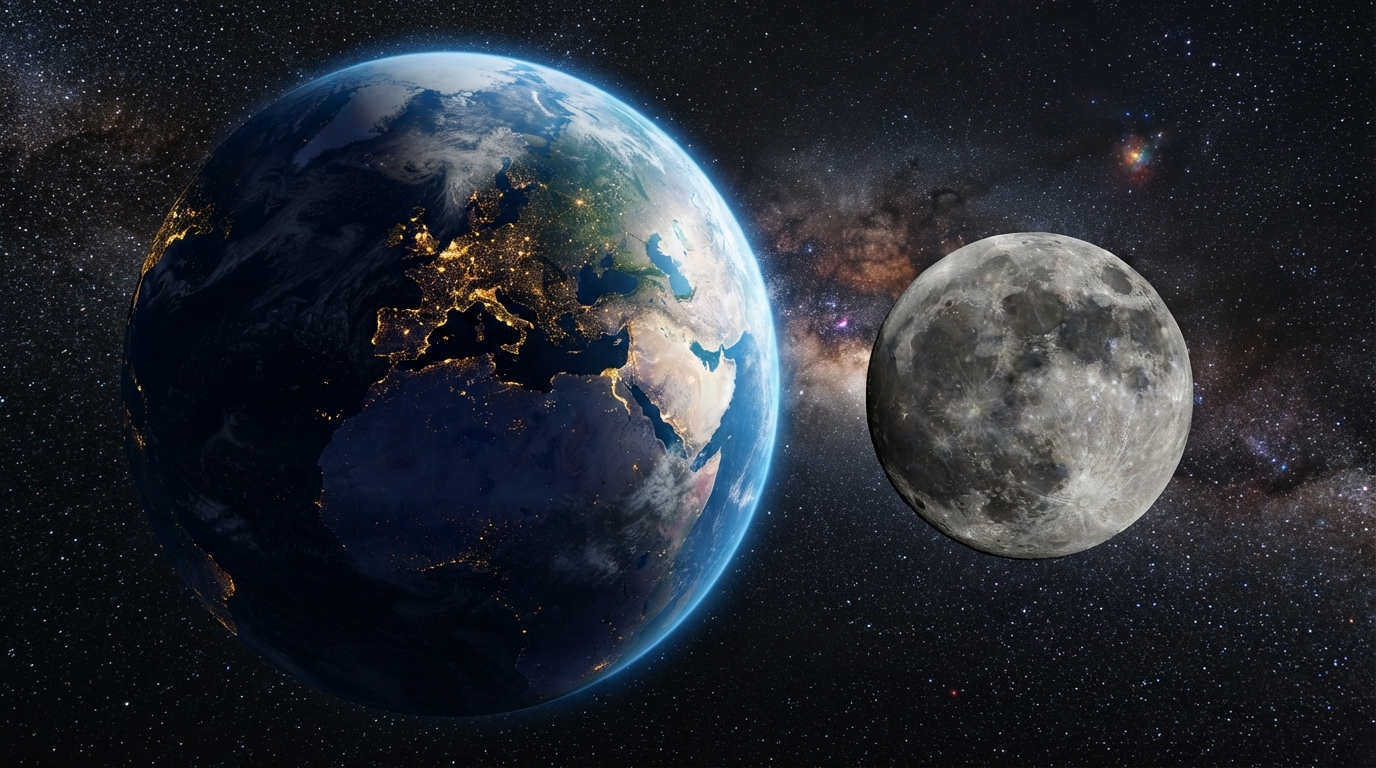
Misconception 1: There Is No Gravity in Space
Astronauts in the ISS float not because there’s no gravity, but because they’re in continuous free fall. The space orbit itself is a state of constant falling. Gravity at 400 kilometers altitude is only about 11% weaker than at Earth’s surface—still very much present.
Misconception 2: Satellites Need Engines to Stay Up
As established earlier, once a satellite achieves the correct velocity for its target space orbit, it continues without propulsion. Engines are needed for orbital adjustments, not for maintaining altitude in most cases.
Misconception 3: All Orbits Are Perfect Circles
In reality, almost all natural and artificial space orbits are ellipses. Some are nearly circular, but perfect circles are extremely rare. Even Earth’s space orbit around the Sun is slightly elliptical.
Misconception 4: Space Is Empty at Orbital Altitudes
Low Earth orbit is increasingly crowded. As of 2024, there are more than 8,000 active satellites and tens of thousands of tracked debris objects sharing this space orbit region. Space traffic management has become a genuine concern for space agencies worldwide.
Final Thoughts: Why Understanding Space Orbits Matters
The physics of a space orbit—gravity, velocity, and the elegant balance between them—underpins nearly everything humans have achieved beyond Earth’s surface. From the GPS chip in your pocket to the telescopes mapping the universe, it all begins with a fundamental question: how do we get something to fall around a planet rather than into it?
Once you grasp how a space orbit works, the night sky looks different. Every pinprick of light that moves a little too steadily, a little too predictably, tells a story of physics in action. Humanity has placed objects in space orbit for scientific discovery, for communication, for navigation, and increasingly, for commerce. Understanding the mechanics behind it isn’t just for scientists—it’s for anyone curious about how the modern world actually works.
Frequently Asked Questions
1. What is a space orbit in simple terms?
A space orbit is the curved path an object follows around a planet or star. It’s maintained by a balance between gravity pulling the object inward and the object’s forward velocity carrying it sideways. The result is a continuous loop—or more precisely, an ellipse—around the central body.
2. Why do satellites not fall to Earth if gravity is pulling them?
Satellites are actually falling constantly, but they’re also moving sideways so fast that Earth’s surface curves away at the same rate they fall. This continuous balance—falling while missing the ground—is what defines a stable space orbit.
3. How long does it take a satellite to complete one orbit?
It depends on altitude. A satellite in low Earth orbit completes a full revolution in about 90 minutes. A satellite in geostationary orbit takes exactly 24 hours, matching Earth’s rotation and appearing stationary from the ground.
4. What is the difference between low Earth orbit and geostationary orbit?
Low Earth orbit sits between 200 and 2,000 kilometers altitude, offering fast orbital periods and low signal latency. Geostationary orbit is fixed at 35,786 kilometers, where satellites appear stationary and can cover large portions of Earth continuously. Each serves different mission types.
5. How does the International Space Station maintain its orbit?
The ISS orbits at about 400 kilometers, where slight atmospheric drag gradually lowers its altitude. To compensate, the station performs periodic reboost maneuvers using onboard thrusters or thrusters from docked cargo spacecraft, keeping it within its operational space orbit range.
6. What are the main types of orbits used by satellites?
The primary types include Low Earth Orbit (LEO), Medium Earth Orbit (MEO), Geostationary Orbit (GEO), Polar Orbit, and Sun-Synchronous Orbit (SSO). Each is suited to specific mission requirements based on altitude, coverage area, and orbital period.
7. Can a space orbit decay over time?
Yes. In low Earth orbit, thin atmospheric drag slowly saps orbital energy, causing gradual altitude loss. Without periodic reboosts, satellites eventually re-enter Earth’s atmosphere. At higher altitudes, like geostationary orbit, this effect is negligible over operational lifetimes.
8. What speed does a satellite need to maintain a space orbit?
Orbital speed depends on altitude. In low Earth orbit, satellites travel at approximately 7.8 kilometers per second (about 28,000 km/h). In geostationary orbit, the required speed drops to about 3.07 kilometers per second due to the weaker gravitational pull at that distance.
9. How do planets stay in stable orbits around the Sun?
Planets follow elliptical paths governed by the Sun’s gravitational pull and their own forward momentum. This balance—identical in principle to satellite space orbits—keeps planets on predictable paths. Johannes Kepler’s three laws and Newton’s law of gravitation describe this mathematically with high precision.
10. Is space orbit mechanics relevant to everyday life?
Absolutely. GPS navigation, weather forecasting, television broadcasting, internet connectivity, and environmental monitoring all depend on satellites in carefully calculated space orbits. The orbital mechanics developed over centuries of science now touch nearly every aspect of modern daily life.
